

SPECIMEN TREE MOVING
Specimen Tree Moving Services in the Hamptons
Relocating Nature’s Masterpieces with Precision and Care
Moving a mature specimen tree is part science, part art, and entirely specialized work that requires expertise most landscapers simply don’t possess. At Hampton Rustic Landscapes, specimen tree moving represents one of our most distinctive services—a craft that founder Matt Stengel has refined over more than two decades of hands-on experience. Whether you’re relocating a century-old oak to save it from construction, repositioning a beloved tree to improve your landscape design, or sourcing and installing mature specimens to create instant impact, our team brings the knowledge, equipment, and meticulous attention to detail that determines whether a tree survives and thrives or struggles and declines.
In the Hamptons, where mature trees contribute significantly to property character and value, the ability to successfully move large specimens opens design possibilities that would otherwise require decades of growth to achieve. Our track record speaks for itself—trees we’ve moved continue to flourish years later, often showing remarkable resilience once properly established in their new locations.
The Hampton Rustic Approach to Tree Moving
Two Decades of Specialized Expertise
Matt Stengel began his career under the mentorship of a respected local landscape expert, learning the fundamentals of specimen tree moving at age 22. Over the subsequent twenty-plus years, he has continuously refined these skills, developing proprietary techniques and tackling increasingly challenging moves. Each project has added to our collective knowledge—understanding root systems, mastering the biomechanics of large trees, perfecting timing and methodology, and learning which species transplant successfully and which prove more temperamental.
This isn’t work you learn from a manual or weekend seminar. It’s knowledge gained through decades of actually moving trees, problem-solving unexpected challenges, and refining techniques based on long-term survival rates. When we move a specimen tree, we’re drawing on hundreds of previous moves—knowledge that simply cannot be rushed or replicated.

Proprietary Techniques and Custom Equipment
The methods we use today aren’t the same ones Matt learned twenty years ago. Through continuous innovation and problem-solving, we’ve developed specialized approaches that significantly improve tree survival rates and allow us to safely move specimens that many contractors would consider impossible.
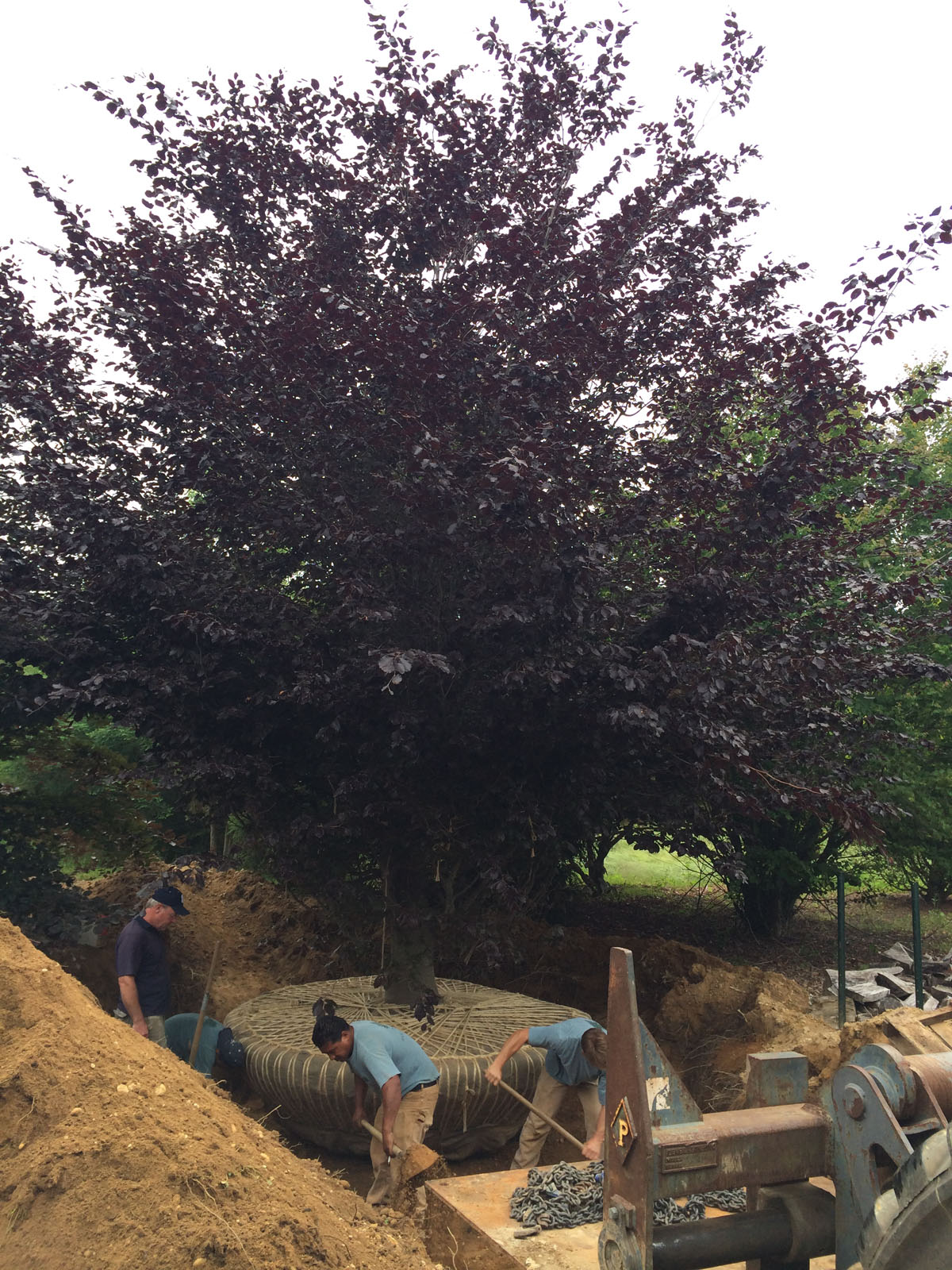
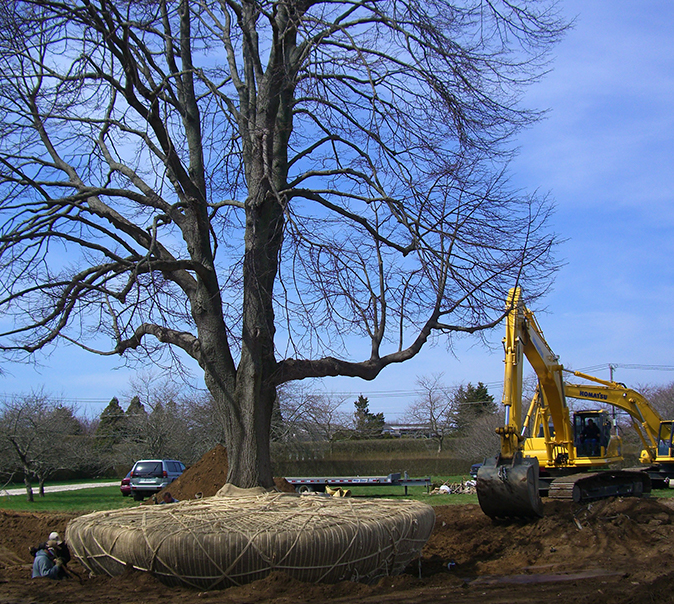
Our custom steel plate system exemplifies this innovation. Moving a large tree requires supporting massive weight while preserving the critical root ball that keeps the tree alive. Our solution involves precision-engineered steel plates paired with heavy-duty straps specifically designed for tree moving. After meticulously wrapping the root ball, we secure the tree to these plates, creating a stable platform that allows safe transport without compromising root integrity.
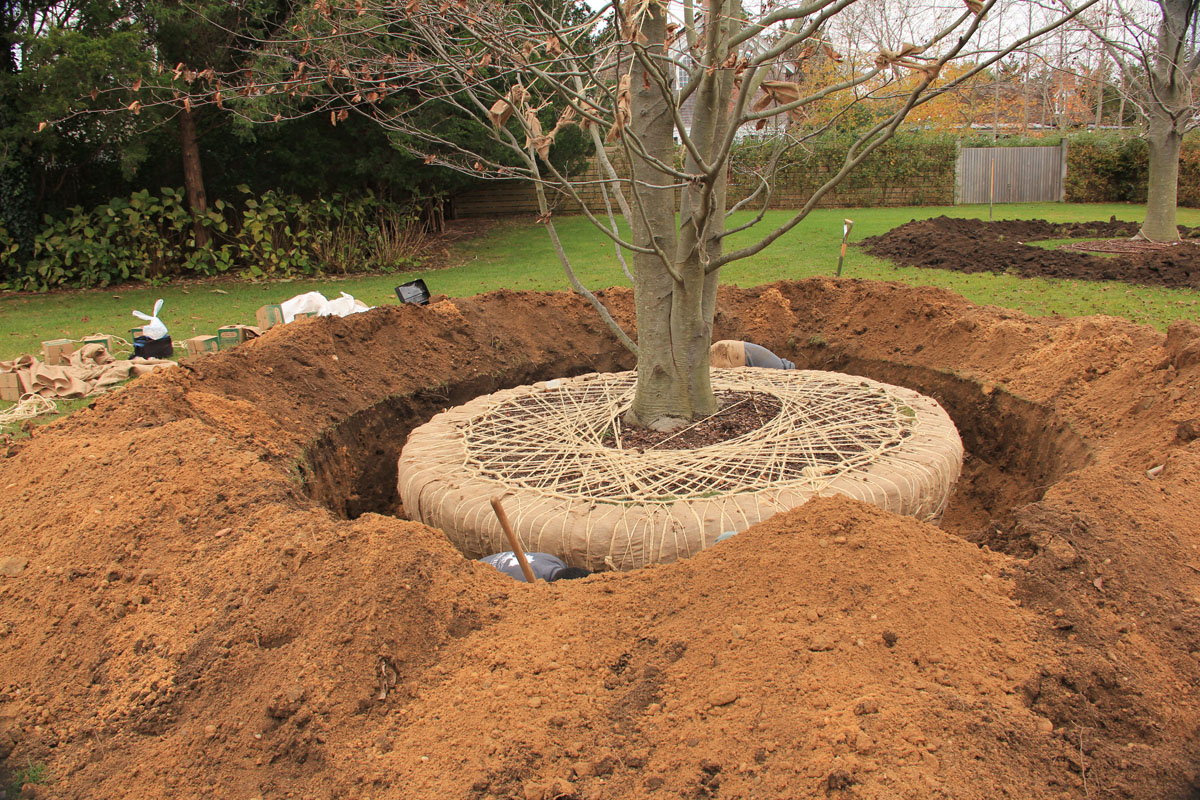
We’ve also perfected the art of root ball wrapping itself—a critical skill that directly impacts tree survival. The intricate weaving pattern of twine around burlap provides structural support for the root mass while the tree is lifted, moved, and replanted. This traditional technique, executed properly, makes the difference between a root ball that maintains its integrity and one that falls apart, often fatally damaging the tree.
The specialized equipment in our arsenal—from custom-built ramps to hand fabricated steel plates—represents significant investment, but more importantly, it reflects our commitment to doing this work at the highest level. We’ve built or sourced every piece of equipment specifically for the demands of moving large specimen trees safely and successfully.
The Specimen Tree Moving Process
Phase 1: Assessment and Planning (6-12 Months Before Move)
Successful tree moving begins long before the actual relocation. When you contact us about moving a specimen tree, we start with comprehensive assessment:
Tree Evaluation: We examine the species, size, age, current health, and structural condition of the tree. Some species transplant more successfully than others. A tree showing signs of stress, disease, or structural weakness may not be a good candidate for moving. We assess honestly—if we don’t believe a tree will survive the move, we’ll tell you upfront rather than taking on a project likely to fail.
Site Analysis: Both the current location and proposed new site receive careful evaluation. We consider access for equipment, underground utilities, root spread, and any complications that might affect the move. The new location must provide appropriate growing conditions—proper sun exposure, adequate soil volume, drainage, and space for the mature tree’s canopy and root system.
Timing Determination: Tree moves must occur during dormancy when trees can handle the stress most effectively. We schedule moves for late fall through early spring, avoiding the growing season when trees are actively photosynthesizing and most vulnerable to transplant shock.
Preparation Protocol: For trees we’re moving 6-12 months out, we implement a preparation program that dramatically improves survival rates. This begins with careful root pruning—creating a defined root ball that encourages new feeder root development within the area we’ll be moving. This isn’t aggressive pruning; it’s gentle, strategic cuts that help the tree adapt before the actual move.
Following root pruning, we begin intensive nutrient supplementation. Using liquid fertilizers applied directly to the soil, we flood the root zone with specialized nutrients—root stimulants to encourage new growth and winter hardiness formulas to strengthen the tree before its ordeal. Liquid application delivers nutrients directly to roots far faster than granular products, critical when time is limited.


Phase 2: Pre-Move Preparation (Weeks Before)
As the move date approaches, preparation intensifies:
Crown Reduction: For larger specimens, we often perform selective pruning to reduce canopy size. This serves two purposes—it makes the tree easier to handle during the move, and it reduces the leaf surface area the compromised root system must support after replanting. This pruning is done strategically to maintain the tree’s natural form while improving its chances of survival.
Root Ball Planning: We calculate the appropriate root ball size based on the tree’s trunk caliper. Industry standards provide guidelines, but we also factor in species characteristics, tree health, and site conditions. Too small a root ball compromises survival; unnecessarily large root balls create handling difficulties and additional expense without proportional benefit.
Equipment Staging: Large equipment operations require careful logistics. We coordinate equipment access, ensure proper ground protection to prevent property damage from heavy machinery, and verify clearances for tree transport.
Phase 3: The Excavation
On move day, our experienced crew begins the meticulous work of excavating around the tree:
Careful Digging: Using specialized equipment and hand tools, we excavate around the tree, working methodically to preserve the root ball. The goal is to dig deeply enough to capture the critical root mass—often four to five feet down for substantial trees—while creating a manageable size for lifting and transport.
Root Ball Shaping: As excavation progresses, we shape the root ball, creating a stable form that will hold together during the move. Major roots are cut cleanly rather than torn, reducing stress and encouraging faster healing.
Strategic Support: While we can excavate deeply around the sides, the area directly beneath the root ball remains supported by undisturbed soil until the final moments before lifting. We dig under as much as practical, leaving the area directly under the tree for a clean cut with a specially engineered steel cable.

Phase 4: Root Ball Wrapping and Securing
This phase showcases traditional skills refined through decades of practice:
Burlap Application: We wrap the root ball in layers of burlap, creating a protective barrier that holds soil against roots while allowing moisture movement. Strategic tree limbs and branches within the canopy are carefully secured with special twine to help support and minimize breakage.
Twine Weaving: The critical step involves weaving twine in specific patterns around the burlapped root ball. This isn’t random wrapping—it’s a traditional technique with roots in old-world forestry, creating a web of support that maintains root ball integrity under stress. The pattern must be tight enough for support but not so constrictive that it damages roots.
Strap Placement: Our heavy-duty straps, specifically manufactured for tree moving, are positioned around the wrapped root ball. These straps will bear the tree’s full weight during transport, so proper placement and tension are critical.
Steel Plate Integration: For our largest moves, we incorporate our custom steel plate system. The tree is carefully positioned onto the plate, and the strap system is integrated with the plate to create a stable platform for moving and transport. This innovation allows us to move trees that would otherwise require equipment beyond what’s practical for residential properties.
Phase 5: The Move and Transport
Moving the tree requires precise heavy equipment operation, strong communication, and careful coordination:
Equipment Operation: Utilizing our heavy equipment, we shift the tree slowly and steadily, monitoring the root ball and strapping system throughout. The tree is carefully observed to make sure obstacles are cleared along its journey.
Transport Strategy: Depending on distance and site conditions, the tree may travel directly to its new location, be loaded onto a specialized trailer, or some combination. Every movement is deliberate, with crew members monitoring the root ball and tree canopy continuously.
Site Protection: Throughout the process, we protect your property using ground protection mats, careful equipment positioning, and strategic routing to minimize any impact from heavy machinery.


Phase 6: Replanting and Establishment
The new planting hole has been prepared during excavation of the original tree:
Proper Sizing: The new hole is wider than the root ball but precisely the correct depth. One of the most common failures in tree planting occurs when trees are set too deep. We locate the root flare—where the trunk begins to widen into roots—and ensure it sits slightly above final grade, accounting for natural settling.
Soil Preparation: The backfill soil is carefully prepared. If existing soil is poor, we may amend it, but drastic changes in soil composition between root ball and surrounding soil can create problems. The goal is soil that drains well while holding adequate moisture.
Strategic Placement: The tree’s orientation matters for both aesthetic reasons and tree health. We consider sight lines from key viewing locations, balance the canopy for wind resistance, and position the tree’s “good side” toward primary views. For deciduous trees, we consider seasonal sun angles and how winter shadows will fall.
Careful Backfilling: Soil is added in layers around the root ball, with each layer carefully settled to eliminate air pockets without excessive compaction. We water thoroughly during backfilling to help settle soil and ensure good contact between root ball and backfill.
Staking System: Large transplanted trees require staking to prevent wind rock while roots re-establish. We use a guying system that provides support without rigidly constraining the trunk. Trees need some movement to develop strong wood, but excessive movement disrupts new root growth.
Phase 7: Post-Move Care and Monitoring
The move itself is only part of success—establishment care determines whether the tree ultimately thrives:
Immediate Watering: Newly moved trees receive deep, thorough watering immediately after planting and regularly throughout the establishment period. We create a watering basin around the tree to direct water to the root zone.
Mulch Application: A generous layer of organic mulch helps retain moisture, moderate soil temperature, and suppress competing vegetation. The mulch is kept away from direct trunk contact to prevent disease issues.
Monitoring Protocol: During the critical first growing season, we monitor the tree regularly for signs of stress, adjusting irrigation as needed and addressing any issues immediately. Some leaf drop or branch dieback is normal as the tree adjusts, but excessive stress requires intervention.
Nutrient Support: We continue specialized fertilization through the establishment period, supporting the tree as it extends new roots into surrounding soil.
Pruning Management: We perform any additional corrective pruning during the first dormant season, removing any branches that died back during establishment while maintaining the tree’s natural form.

What Sets Hampton Rustic Apart
Unmatched Experience: Two decades of specialized experience moving specimen trees isn’t just a marketing claim—it’s knowledge that shows in survival rates, problem-solving ability, and the confidence to tackle challenging moves. We know which species transplant readily and which prove difficult. We understand how different soil types affect root ball stability. We’ve learned through experience what works and what doesn’t.
Comprehensive Capabilities: Many contractors claim to move trees but ultimately subcontract the work. We handle every phase internally—from initial assessment through years of establishment care. This continuity means nothing gets lost in translation, and we maintain full accountability for results.
Proper Equipment Investment: Our custom steel plates, specialized straps, and carefully selected machinery represent significant investment, but that investment translates directly into successful moves. We have the equipment to do this work at the highest level because this is core to our business, not an occasional service we offer.
Honest Assessment: We turn down projects when we don’t believe a tree will survive the move. While this costs us business in the short term, it reflects our commitment to doing this work ethically and protecting our reputation for successful outcomes.
Long-Term Perspective: We judge success not by whether a tree survives the first month, but whether it’s thriving years later. This long-term perspective influences every decision we make—from preparation protocols to establishment care plans.
Common Scenarios for Tree Moving
Construction Avoidance: Perhaps you’re building an addition, installing a pool, or making other improvements that would require removing a beloved tree. If the tree is healthy and relocating it elsewhere on your property is feasible, moving it preserves that living legacy while allowing your project to proceed.
Landscape Redesign: Sometimes the perfect tree is in the wrong spot. Maybe it’s blocking a view, too close to the house, or simply not where you’d put it if starting fresh. Moving it to a better location can solve multiple design challenges while preserving a mature specimen that would cost tens of thousands to replace with similar size stock.
Property Purchase Opportunities: Occasionally, properties slated for development contain specimen trees that would otherwise be lost. If you have suitable space on your property, rescuing and relocating these trees can add instant maturity to your landscape at a fraction of the cost of purchasing equivalent stock from a nursery.
Strategic Enhancement: Perhaps your property has adequate trees but lacks them in key locations—a focal point in your front yard, a shade tree for your patio, or specimens to frame views. Moving mature trees from less important locations to strategic positions can dramatically improve your landscape.